
Whatever you’re doing to earn trust right now will probably stop being the advantage you think it is. Most forms of earned trust follow a similar arc. They work, access expands, the signal dilutes, and the premium moves somewhere else. The form doesn’t disappear, it just stops differentiating.
Celebrity endorsements still work, but not the way they did when celebrity was scarce. Infomercials still exist, but not as a novel format commanding premium attention. Influencer marketing still reaches people, but “real person, honest opinion” is no longer a genuinely novel proposition. As each form democratized — more people could do it, more brands could buy it — the signal diluted because of its own success. The dynamic hasn’t changed from Suzanne Somers selling ThighMasters on late-night television to a twenty-three-year-old selling protein powder on TikTok. What changed is how many people can do it and the transparency around it, which is exactly what compresses the premium.
One of Us Is the Bougie Sister
My sister lives in suburban Virginia and thinks TripAdvisor is a reputable source. It was, once. Reviews from real customers, emergent ranking. It was a good guide. Then came review fraud, pay-to-play incentives, algorithm manipulation. I noticed and left. She hasn’t noticed and hasn’t left. We are both right about TripAdvisor in our own way (or so I tell her).
Trust erodes in layers, not all at once. The people who notice leave first. The people who haven’t noticed are still there. The same signal working and failing simultaneously, depending on who’s reading it. Sociologists call this stratification. Brands should call it a planning problem.
Only thirteen percent of consumers now turn to influencers for purchasing decisions.¹ Nearly half say most influencers are fake — while eighty-eight percent say authenticity matters to them.² This is Goodhart’s Law in action: when a measure becomes a target, it ceases to be a good measure.³ “Authentic recommendation” became the target. Every brand chased it. The authenticity evaporated.
Mega-influencers became indistinguishable from ads, so some trust migrated to micro-influencers, who felt more like peers. That layer is now compressing. The trust didn’t die. It just moved down a floor.
The influencer model isn’t going away completely. There are still demographics you reach effectively through it, the same way there are still demographics you reach on Facebook. The question is whether you know where your customers actually are versus what platforms tell you. These are frequently not the same.
Borrowed Proof
Every brand knows that you need some social proof in the path to purchase. So all DTC checkout pages boast the same visual syntax: “As seen in Forbes,” “Featured in Vogue,” trust badges stacked like medals. This is borrowed trust that is manufactured. Nobody’s reputation is at stake so it’s pretty meaningless. The cost of verification sits with the customer, not the brand. And when every brand is saying the same thing, “trust” dissolves into decoration. Mayer, Davis, and Schoorman studied what people are actually evaluating when they decide to trust. Competence, can you do what you claim? Benevolence, do you actually want good things for me? Integrity, are you consistent in your principles?⁴ The badges don’t give the buyer anything real to evaluate on any of those dimensions.
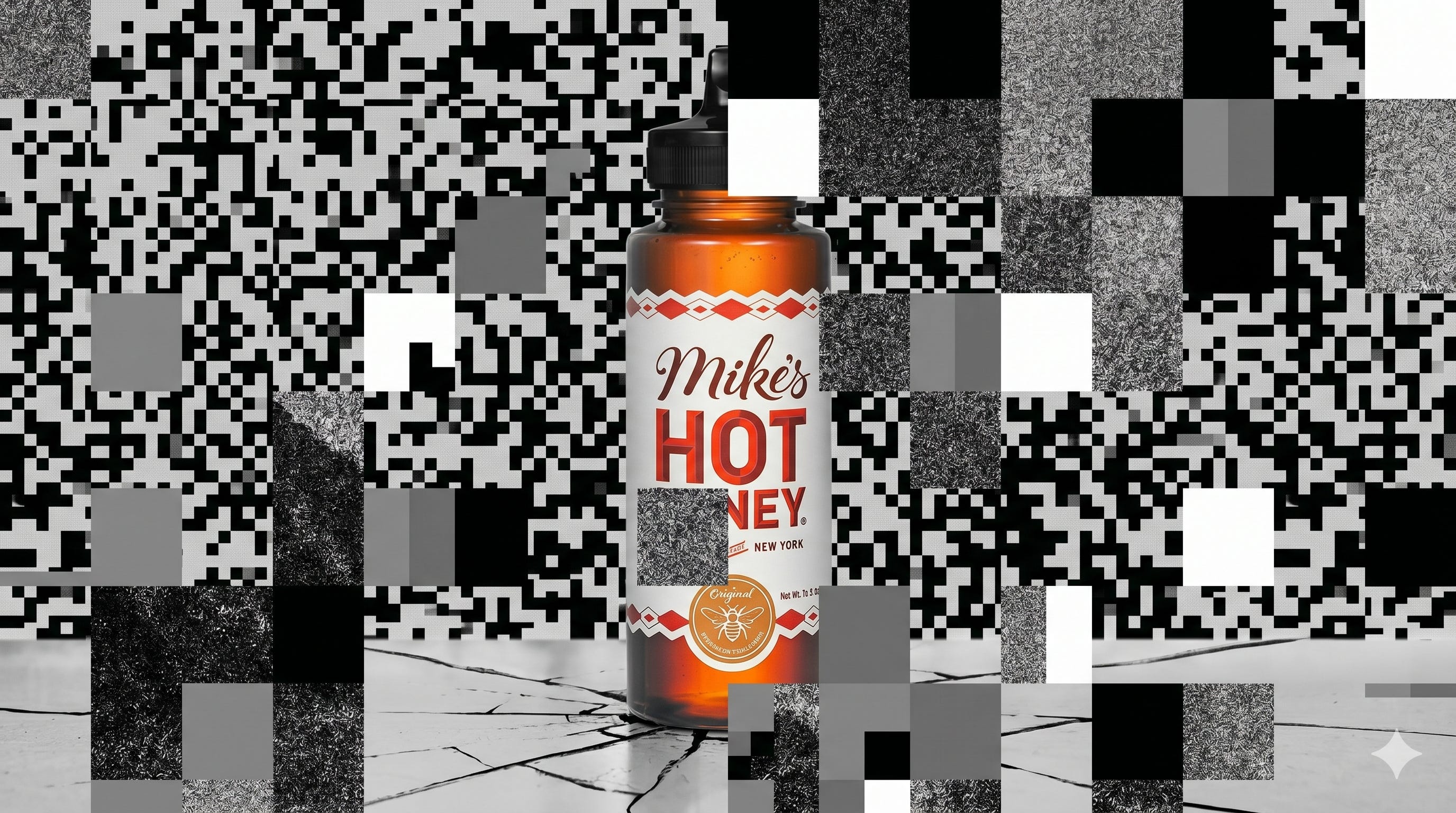
Borrowed trust that is earned looks different. In 2010, Mike Kurtz was selling chili-infused honey at Paulie Gee’s in Greenpoint, Brooklyn. Paulie Gee put it on his pizza. The product spread through the chef community — cooks pulling it into their own kitchens, staking their own plates on it. That’s not a badge. That’s the whole game. Four years in restaurants and on menus before the first grocery placement.⁵ Today: 30,000 retail locations. Forty million dollars a year. One product. Competence, benevolence, integrity not just claimed on a label but tested nightly, by someone else’s customers, on someone else’s reputation.
The Edit
Trader Joe’s carries about four thousand products. A conventional supermarket carries thirty to fifty thousand.⁶ Eighty percent of what Trader Joe’s sells is their own label. No sales. No coupons. The price on the shelf is the price. Every one of those decisions is trust built into the transaction, not into the marketing. The company stakes its reputation on every single item; nothing gets to hide. The result: $2,200 in sales per square foot, nearly four times Walmart.⁷ No traditional advertising. The brand doesn’t have trust. Trust is what the brand is.
Zucker drew a distinction that’s important between interpersonal trust, that is confidence in a specific person, and institutional trust which is confidence in systems, processes, and policies.⁸ Mike’s Hot Honey started as interpersonal trust. One chef, one pizza, one jar. Trader Joe’s is what happens when you build that into a company’s offering. The curation is the product. The edit is the trust.
Institutional trust is what lets the unknown survive. For example, when you pull a novel off the staff picks shelf at your favorite bookstore because the person who picked works at the store you love and put their name on the card so you can chat about it at checkout. The institution does the editing. The unknown survives because someone else’s credibility said: this is worth your attention.
It is important to be clear that all this is different from a recommendation engine. A recommendation engine says: based on your past behavior, here are things you might like. It’s backward-looking, data-driven, and optimized for conversion. It doesn’t have a point of view, it has a model. And when it’s wrong, nobody’s reputation is at stake. What humans have done for each other, traditionally, is different. Someone with conviction edits the world down for you, and you trust them enough to let them propose your consideration set. The distinction matters because a recommendation engine can be gamed. Guided discovery can only be earned.
Own the Mechanism
Amazon does $717 billion a year⁹ offering the opposite of curation: unlimited choice, algorithmic sorting, same-day delivery. The infinite shelf wins by every conventional metric. But when you don’t know what you want yet, the algorithm doesn’t have a point of view. It has a grid.
Brands that built something durable often move the burden of proof onto themselves. They made decisions that cost them something: fewer SKUs, four years without a grocery placement, a return policy that absorbs the risk. Those aren’t marketing choices. They’re structural ones. And they compound over time rather than diminish, which is exactly why they work when the borrowed version stops.
You can keep renting trust from platforms and influencers and badges. It still works, for now, for some customers. But the premium is moving. And you don’t own any of what you’ve rented.
¹ Oracle and CRM Essentials, “37% of Consumers Trust Social Media Influencers Over Brands,” May 2022.
² Harvard Business Review, “How to Do Influencer Marketing That Customers Actually Trust,” December 2025.
³ Goodhart, C., “Monetary Relationships: A View from Threadneedle Street,” 1975. Popularly paraphrased as: “When a measure becomes a target, it ceases to be a good measure.”
⁴ Mayer, R.C., Davis, J.H. & Schoorman, F.D., “An Integrative Model of Organizational Trust,” Academy of Management Review, 20(3), 1995. Original terms are “ability,” “benevolence,” and “integrity”; paraphrased here for readability.
⁵ Kurtz began selling Mike’s Hot Honey at Paulie Gee’s in Greenpoint, Brooklyn in 2010, inspired by chili-infused honey he’d tasted on pizza in São Paulo. CNBC, “How Mike’s Hot Honey Built a $40 Million a Year Business with a Single Product,” November 2023. First Whole Foods placement 2014; now in 30,000+ retail locations.
⁶ Trader Joe’s carries approximately 4,000 SKUs versus 30,000–50,000 at a conventional supermarket. Private label accounts for approximately 80% of its product mix versus an industry average of 15–20%.
⁷ Trader Joe’s sales per square foot estimated at $1,750–$2,130, versus approximately $400–$500 for Walmart. Trader Joe’s does no traditional advertising.
⁸ Zucker, L.G., “Production of Trust: Institutional Sources of Economic Structure,” Research in Organizational Behavior, 8, 1986. ⁹ Amazon 2025 annual revenue: $717 billion. U.S. e-commerce market share approximately 37–40%.